
Rechargeable LED Camping Lantern Review: Is It Worth Taking on Your Next Trip?
A camping lantern has a slightly different job from a conventional flashlight. A flashlight is usually pointed at something specific, while a lantern is meant to make the space around you easier to see.
That distinction becomes noticeable after sunset. You may need light while arranging a tent, sorting equipment, preparing food or looking for something in the car. Holding a flashlight in one hand works, but it is not always the most convenient solution.
A rechargeable LED camping lantern can approach these situations differently. Instead of relying only on handheld illumination, it can be placed, hung or attached to a suitable metal surface.
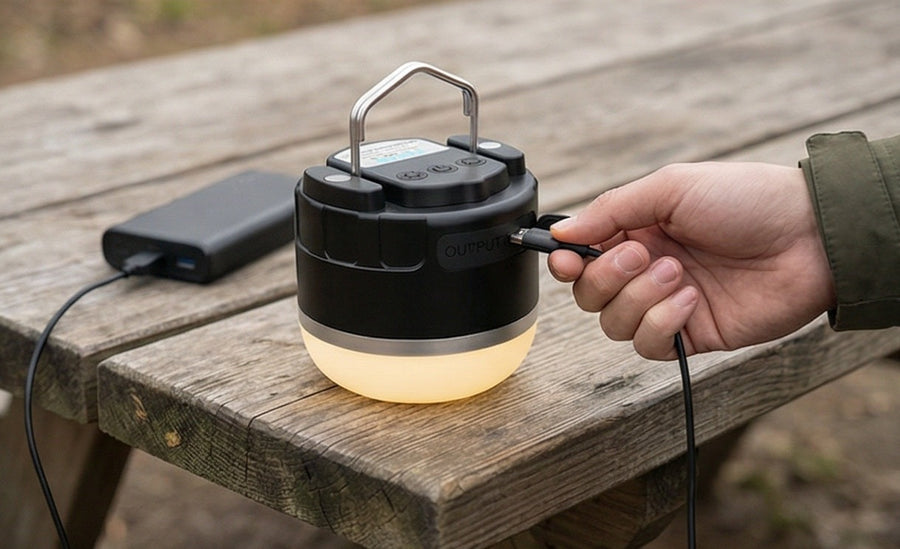
The rechargeable camping lantern reviewed here has a 4000 mAh rechargeable battery, three brightness levels, a magnetic base, a hanging handle and IP65 protection.
So, is that combination actually useful on a trip, or does it simply sound good in a product specification?
What Problem Is a Camping Lantern Supposed to Solve?
The main advantage of a lantern is not necessarily brightness. It is having light available without needing to hold the device continuously.
Imagine setting up a tent after dark. One hand may be holding a tent pole while the other is dealing with a fastening or piece of equipment. A handheld flashlight immediately becomes less convenient.
A lantern that can be hung or placed somewhere nearby changes the situation. The light stays in one position while you continue working.
There is also a difference between illuminating one object and illuminating an area. A lantern is generally more useful for the second task.
This is where the design of a rechargeable LED camping lantern becomes more interesting than simply looking at its maximum brightness.
Rechargeable Battery: Useful, but Preparation Still Matters
The lantern has a built-in 4000 mAh rechargeable battery.
For camping, the main benefit is straightforward: there is no need to carry a separate set of disposable batteries specifically for the lantern.
According to the stated specifications, the operating time can reach approximately 6–8 hours on medium brightness and up to 12 hours on low brightness.
Actual runtime depends on the selected brightness and conditions of use. A higher output generally consumes more energy, while a lower setting can extend the available operating time.
This makes the charging routine important. A rechargeable lantern is convenient when it is charged before the trip; a large battery does not help much if the device was left nearly empty in a cupboard.
For occasional emergency use at home, the same principle applies. It is worth checking the charge periodically if the lantern is being kept as backup lighting.
Three Brightness Modes Are More Useful Than One Fixed Output
Maximum brightness sounds attractive, but camping does not always require maximum brightness.
Reading inside a tent is different from illuminating a larger area around the campsite. Using the same high output for both tasks can be unnecessary.
The lantern provides three brightness levels:
- Low for reading, close-up tasks and softer illumination
- Medium for general use
- High when more light is needed over a larger area
The useful part is the ability to choose rather than being locked into one output.
It also gives you some control over battery consumption. If low brightness is enough for a particular task, there is little reason to use the highest setting.
The Magnetic Base Is Particularly Interesting Outside the Tent
The magnetic base is one of the features that changes the lantern's possible uses.
If there is a suitable metal surface, the lantern can be attached rather than placed on the ground or held in your hand.
This can be useful when:
- working under a car hood;
- checking something inside a vehicle;
- working in a garage;
- carrying out a repair where both hands are needed.
For a camping trip, the magnetic function may not be used every day. But if the lantern also serves as a vehicle or workshop light, it becomes much more relevant.
The limitation is simple: the magnetic base requires a suitable metal surface. It is therefore an additional positioning option, not a universal mounting system.
Hanging the Lantern Can Be More Important Than It Looks
The lantern also has a metal handle for hanging.
This is particularly useful when you need to illuminate an area rather than a single point.
Inside a tent, for example, positioning the lantern higher can provide more practical general illumination than carrying it around at waist level. The same idea can work under a shelter or in another suitable location.
It is a small feature, but it changes the lantern from something you simply carry into something you can position according to the situation.
That is an important distinction when evaluating whether a camping lantern is actually practical.
What Does IP65 Protection Add?
Outdoor equipment has to deal with conditions that indoor lighting normally avoids.
The lantern has an IP65 protection rating, providing protection against dust and water jets from different directions.
This can be useful when the lantern is used outdoors where dust, moisture or light rain may be encountered.
However, IP65 does not mean that the lantern should be submerged in water. It should be treated according to the limits of its protection rating rather than as a completely waterproof device.
For a camping product, that distinction matters. Outdoor protection is useful, but it does not remove the need to take reasonable care of electronic equipment.
How Useful Is It on an Actual Camping Trip?
The answer depends partly on what you expect the lantern to do.
For setting up a tent, the ability to hang the lantern or place it nearby can leave both hands available.
For evening activities around a campsite, adjustable brightness allows you to use more or less light depending on the area that needs illumination.
For reading, a lower brightness level may be more appropriate than maximum output.
For cooking or organising equipment, hands-free positioning can be more useful than having an extremely powerful beam.
For night fishing or other outdoor activities, the rechargeable battery removes the need to carry disposable batteries, while the IP65 rating provides protection against dust and water jets within its specified limits.
None of these uses requires the lantern to do something spectacular. The value comes from being able to adapt the same light to several different situations.
It Can Also Leave the Camping Box
One of the stronger practical arguments for this type of lantern is that it does not have to be used only outdoors.
A camping-specific product that sits unused for most of the year has limited everyday value. A rechargeable lantern that can also be used in a garage, vehicle or at home is easier to justify as a general-purpose piece of equipment.
In a Car
The magnetic base can be useful for vehicle-related tasks when a suitable metal surface is available.
It can also provide additional illumination when searching through a dark luggage compartment or dealing with an unexpected problem after sunset.
In a Garage or Workshop
A hands-free light can be useful when both hands are occupied with a repair.
Here, the magnetic base becomes more important than it would be during ordinary camping use.
During a Power Outage
At home, the lantern can serve as backup lighting.
A rechargeable light is particularly practical if it is stored in a known and accessible location. There is little benefit in having an emergency lantern if nobody remembers where it was put.
What Are the Main Advantages and Limitations?
Looking at the complete package gives a more useful picture than simply listing the features.
Advantages
- 4000 mAh rechargeable battery reduces dependence on disposable batteries
- Three brightness levels allow the light output to be adjusted
- Magnetic base provides hands-free use on suitable metal surfaces
- Hanging handle gives another way to position the lantern
- IP65 protection makes it more suitable for outdoor conditions involving dust and water jets
- Compact design allows it to serve more than one purpose
Limitations to Keep in Mind
The lantern still needs to be charged before use.
The magnetic base is only useful where a suitable metal surface is available.
IP65 protection does not make the lantern suitable for immersion.
And although three brightness levels provide flexibility, the actual runtime will depend on how the lantern is used rather than simply on its 4000 mAh battery rating.
These are not unusual limitations for a rechargeable outdoor light, but they are worth considering before deciding whether it fits your particular trip.
Is a Rechargeable LED Camping Lantern Worth Taking?
For someone who only wants a small handheld light for occasional use, a lantern with multiple positioning options may offer more functionality than necessary.
For camping, road trips, fishing, garage work or emergency use at home, the combination becomes more relevant.
The strongest part of the design is arguably not one individual feature. It is the way the features work together: the battery provides portable power, brightness modes control how that power is used, while the magnetic base and hanging handle determine where the light can be positioned.
That makes the lantern less dependent on one specific use.
Final Verdict: What Should You Consider Before a Trip?
A rechargeable LED camping lantern is worth considering when you need more than a conventional handheld flashlight.
The rechargeable camping lantern combines a 4000 mAh rechargeable battery, three brightness levels, a magnetic base, a hanging handle and IP65 protection.
Its practical value comes from this combination rather than from any single specification. You can carry it, hang it or attach it to a suitable metal surface, while the brightness can be adjusted according to the task.
Before taking it on a trip, the most important preparation is simple: charge it fully and make sure you know where it is packed.
For camping and other situations where portable, hands-free area lighting is useful, that combination can make a rechargeable LED camping lantern a practical addition to your equipment.