
SanJie Home Security Alarm System — How a Smart Wi-Fi Alarm System Works
Home security does not always require a complicated system with professional installation and multiple cables running through the property. For many homes, apartments and small workspaces, the more practical question is simply this: what should happen when someone opens a door, enters a room, or something unusual happens while nobody is there?
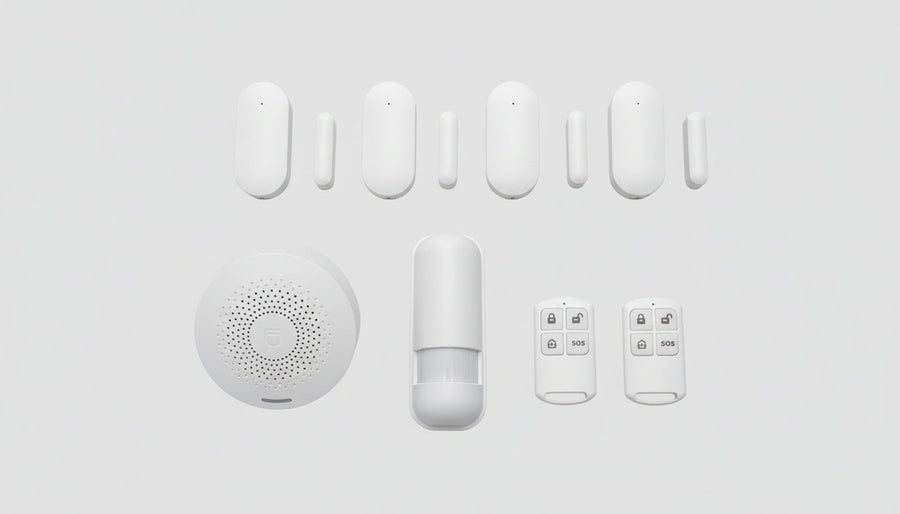
The SanJie Home Security Alarm System combines several basic security functions in one wireless system. It uses door and window sensors, a PIR motion detector, a built-in siren and smartphone notifications through Wi-Fi and the TUYA Smart App.
The interesting part is not any single component. It is the way they work together.
Smart Wi-Fi Alarm System With Smartphone Control
The Wi-Fi home security alarm system connects to your home network and can be managed through the TUYA Smart App.
This means that basic alarm functions do not have to be controlled from the central unit itself. Using a smartphone, you can:
- Arm or disarm the alarm remotely
- Check the system status
- Receive notifications when an alarm is triggered
- Control the system when you are away from home
This can be useful when you work long hours, travel frequently or have a property that you do not visit every day.
Of course, smartphone control does not replace checking the physical security of a property. It simply gives you another way to see what the alarm system is reporting.
What Happens When a Sensor Is Triggered?
A useful way to understand a home alarm system is to look at the sequence of events.
A door or window opens. A motion detector senses movement. The system registers the event and can activate the alarm while also sending a notification to the connected smartphone.
That makes the real-time home alarm notification system useful even when you are not physically inside the property.
The notification itself is important because a siren and a phone alert serve different purposes. The siren is intended to attract attention locally, while the smartphone notification gives the owner information remotely.
Door and Window Sensors for Entry Points
Doors and windows are obvious places to monitor because they are common access points into a property.
The door and window sensors can be used on locations such as:
- Front and back doors
- Windows
- Garage doors
- Balcony or patio access points
This type of sensor is particularly straightforward: instead of trying to determine what is happening throughout the entire room, it focuses on whether a monitored opening has been disturbed.
For a small apartment, for example, it can make sense to start with the main entrance and accessible windows rather than trying to cover every possible area.
PIR Motion Detector for Indoor Movement
Door sensors monitor openings. A PIR sensor approaches the problem differently.
The PIR motion sensor is designed to detect movement within an area, making it suitable for places such as hallways and living rooms.
This gives the alarm system another layer of detection.
A practical setup could therefore use door and window sensors around the perimeter while the PIR detector monitors an important interior area. The two types of sensors are doing different jobs, which is one reason they can work together rather than simply replacing one another.
The exact placement matters. A motion detector should be positioned according to the room layout and the area you actually want to monitor.
Built-In Siren: The Local Alarm
When the system detects an alarm event, the central unit can activate its built-in siren.
The purpose of a siren is fairly simple: create an immediate audible warning.
It can:
- Draw attention to an unexpected event
- Alert people in or around the property
- Act as an additional deterrent during an attempted break-in
The siren and smartphone notification again have different roles. One works at the property itself, while the other keeps the owner informed remotely.
Wireless Remote Controls and SOS Button
Smartphone control is useful, but sometimes reaching for a phone is simply unnecessary.
The system includes wireless remote controls, allowing basic functions to be controlled directly.
Depending on the situation, the remote can be used to:
- Arm the alarm
- Disarm the alarm
- Activate the SOS function in an emergency
This can be convenient for households where more than one person needs access to the alarm system. It also provides a simple alternative to app control.
Wireless Installation and a Simpler Setup
One of the practical differences between a wireless alarm system and a traditional wired installation is the amount of physical work involved.
The wireless home security system is designed so that its sensors communicate wirelessly with the main unit.
That can make installation more convenient because there is no need to run security cables between every sensor and the control unit.
However, “wireless” does not mean that nothing needs to be configured. The sensors still need to be positioned correctly, paired with the system and tested before relying on them.
That small testing step is easy to overlook. It is also one of the more important parts of setting up any alarm system.
Where Can a SanJie Alarm System Be Used?
The SanJie Home Security Alarm System can be used in several types of properties:
- Houses
- Apartments
- Small offices
- Studios
- Small shops
- Vacation homes
For a permanent home, the system can provide everyday monitoring of selected entry points and rooms.
For a vacation property, remote notifications can be particularly useful because the owner may not be there to check the property immediately.
The important point is that an alarm system is only as useful as its placement and configuration. Selecting the doors, windows and rooms that actually matter is more important than simply installing sensors everywhere.
Main Features of the SanJie Home Security Alarm System
The system combines several functions rather than relying on one type of sensor:
✔ Wi-Fi alarm system with TUYA Smart App
✔ Door and window opening sensors
✔ PIR motion detector
✔ Smartphone notifications
✔ Built-in audible siren
✔ Wireless remote controls
✔ SOS button
✔ Wireless communication between components
✔ Smartphone-based system control
Together, these functions cover several different parts of basic home alarm monitoring.
Who Could Use This Type of Alarm System?
A wireless smart alarm system can make sense for people who want basic property monitoring without starting with a large professionally installed security system.
Potential users include:
- Homeowners
- Renters
- Families
- Small office owners
- Small shop owners
- People who regularly travel
- Owners of vacation properties
It is particularly relevant when remote notifications and simple wireless installation are important considerations.
At the same time, this type of system should be viewed as an electronic alarm solution, not as a replacement for every other form of property security. Good locks, sensible access control and appropriate physical security still matter.
Is a Smart Wi-Fi Alarm System Worth Considering?
The main advantage of a system like the SanJie Home Security Alarm System is the combination of several relatively simple functions.
Door and window sensors watch specific entry points. The PIR detector watches movement in an interior area. The siren provides a local audible response, while the TUYA Smart App allows notifications and remote control through a smartphone.
None of these functions is complicated on its own. The value comes from having them work as one system.
For someone looking for a wireless smart home alarm with app control, remote access, entry sensors and indoor motion detection, these are the main features to examine before choosing a system.
Final Thoughts
Home security is rarely about one device doing everything. It is usually about covering the places that matter and knowing what happens when something changes.
The SanJie Home Security Alarm System brings together door and window sensors, PIR motion detection, a built-in siren, wireless remote controls and smartphone notifications.
Its wireless design also makes it suitable for situations where running cables would be inconvenient.
For a house, apartment, small office or vacation property, the useful question is not simply whether an alarm system is installed. It is whether the system monitors the important entry points, covers the areas that need attention and gives you a practical way to respond when an event occurs.