
Is This 130cm Bike Chain Lock Enough to Stop Theft?
Leaving a bicycle unattended can feel uncomfortable, even when you are only going into a shop for a few minutes. The question is not simply whether you have a lock, but whether the lock is practical enough to secure the bicycle properly in the place where you actually leave it.
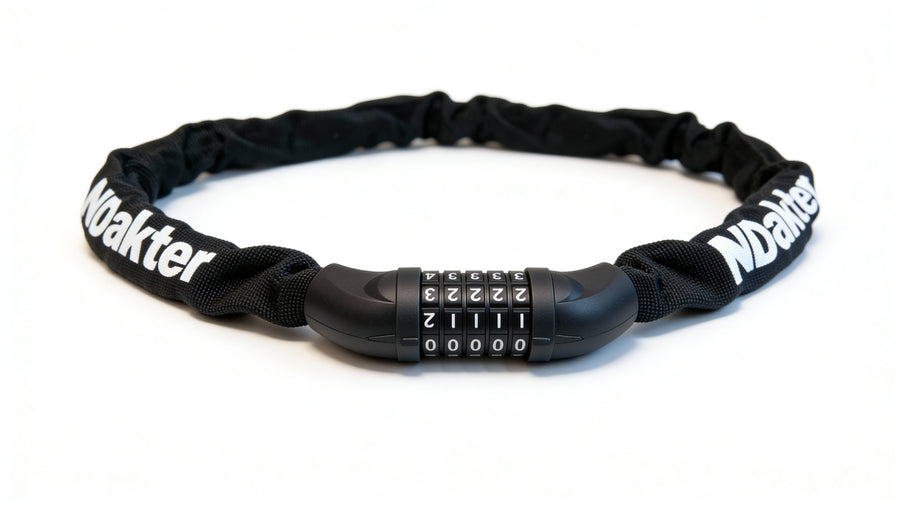
A 130cm bike chain lock with a 5-digit combination approaches the problem from several directions: chain strength, usable length, keyless operation and protection for the bicycle frame.
But is 130 cm really enough? And what does that length mean when you are locking a bicycle in everyday situations?
Why Some Bike Locks Become Problematic in Everyday Use
Not every problem with a bicycle lock is caused by the locking mechanism itself. Sometimes the biggest issue is simply how the lock can be used.
Thin Cable Locks Offer Limited Physical Resistance
Lightweight cable locks are convenient to carry, but their thinner construction generally provides less resistance to cutting than a substantial steel chain.
That does not mean every cable lock is useless. It simply means that the material and construction should match the level of security you expect.
Keys Can Become an Everyday Inconvenience
A traditional key lock requires you to carry and keep track of a physical key.
That sounds insignificant until the key is misplaced, left at home or damaged. For people who use a bicycle every day, avoiding another small object to carry can be surprisingly convenient.
A Short Lock Can Make Good Locking Difficult
This is where chain length becomes more interesting.
If the lock is too short, securing the frame and wheel together can be awkward. You may also have fewer options when the nearest bike rack, pole or railing is not positioned exactly where you want it.
A longer chain does not automatically make a lock more secure, but it can make correct locking much easier.
Metal Against the Frame Can Cause Damage
A chain that repeatedly rubs directly against the bicycle frame can leave scratches over time.
A protective sleeve does not change the fundamental security of the lock, but it can make the lock much more pleasant to use regularly.
So, Is 130 cm Enough?
For many everyday situations, 130 cm provides a useful amount of flexibility.
The exact answer depends on the bicycle, the object you are attaching it to and how you position the chain.
The important point is that 130 cm gives you enough chain to work around the frame, a wheel and a suitable fixed object in many common parking situations.
It is also long enough to avoid some of the awkward positioning that can happen with very short locks.
However, there is no universal length that works perfectly everywhere. If you regularly need to secure a bicycle to unusually large objects, a longer chain may be more practical.
What Does the Hardened Steel Chain Add?
The chain is one of the main physical components of the lock.
This model uses hardened steel, a material commonly chosen for applications where greater resistance to cutting and deformation is required compared with softer metals.
The practical idea is straightforward: a more substantial chain creates a more significant physical barrier than a thin cable.
It is still important to keep expectations realistic. No consumer bicycle lock should be treated as completely impossible to defeat. The purpose is to make unauthorized removal more difficult and to provide a stronger level of resistance than a basic lightweight lock.
What About the 5-Digit Combination?
The combination system solves a different problem.
A 5-digit code provides up to 100,000 possible combinations, while eliminating the need for a physical key.
For everyday use, this can be particularly convenient. You can leave the key out of the equation entirely and simply enter the code when you need to unlock the bicycle.
It can also work well when several people use the same lock, since there is no physical key that needs to be passed between them.
The combination system should be viewed as a convenience and security feature working alongside the physical chain, not as a replacement for it.
The Protective Sleeve Is More Useful Than It Looks
The fabric sleeve around the chain is easy to overlook when reading the specifications.
In practice, it addresses a simple problem: metal chains and painted bicycle frames are not a great combination when they are constantly rubbing against each other.
The sleeve creates a layer between the chain and the frame, helping reduce scratches during normal use.
It also makes the chain easier to handle, particularly when wrapping it around a bicycle or carrying it after use.
Where Does a 130 cm Chain Lock Make Sense?
Daily Commuting
If you regularly leave your bicycle near an office, shop, school or transport station, a practical lock needs to be quick enough to use without becoming a daily annoyance.
The 130 cm length gives you flexibility when the available parking structure is not positioned exactly where you would prefer.
Urban Parking
City environments often mean working with whatever fixed object is available.
A longer chain can make it easier to adapt to bike racks, suitable railings and poles rather than choosing a parking position based solely on the length of the lock.
E-Bikes and Scooters
The same flexibility can be useful with e-bikes and some scooters.
However, the value of the equipment being protected should always be considered. More expensive equipment may justify using more than one security measure.
Home and Outdoor Equipment
The chain is not necessarily limited to bicycles.
Depending on the size and situation, it can also be used for scooters, gates, strollers and some outdoor equipment.
This makes the lock more versatile if you want one mechanical security solution for several everyday uses.
Security Without Carrying a Key
There is something simple about a combination lock: there is one less thing to remember.
For regular bicycle use, that can matter more than it initially seems. You do not need to check whether the key is in your pocket before leaving home.
You simply need to remember the combination.
The trade-off is equally simple: if you forget the combination, the convenience disappears very quickly. Choosing a code that you can reliably remember is therefore part of using the lock properly.
Is It Practical for Everyday Use?
A bicycle lock does not have to be complicated to be useful.
The mechanical combination system requires no batteries or electronic components. That means there is no charging routine and no electronic part to depend on during normal use.
The combination of the steel chain and protective sleeve is also suited to repeated handling.
Still, durability does not mean that the lock should be exposed unnecessarily to extreme conditions or treated as indestructible. Like any mechanical security product, it benefits from sensible use and basic care.
What Does This Lock Actually Solve?
Looking at the product as a whole, its main advantages are fairly straightforward:
- 130 cm chain — provides more flexibility when securing the bicycle.
- Hardened steel — offers a more substantial physical barrier than a basic thin cable.
- 5-digit combination — removes the need for a physical key.
- Protective sleeve — helps reduce contact between the chain and bicycle frame.
- Versatile use — can be suitable for bicycles and other equipment when the dimensions and security requirements fit.
None of these features alone guarantees that a bicycle cannot be stolen.
Together, however, they address several common practical problems that appear when using a bicycle lock every day.
Is a 130 cm Bike Chain Lock Enough for Your Bicycle?
The answer depends on what you need from it.
If you usually park in ordinary bike racks or near suitable fixed objects, 130 cm can provide a useful balance between flexibility and manageable size.
If you need to secure a bicycle around unusually large structures, you may prefer a longer chain.
The security level you need also depends on the bicycle itself, where you park it and how long it is normally left unattended.
So the more useful question is not simply “Is 130 cm enough?” but rather:
Is 130 cm enough for the way I actually lock my bicycle?
For many everyday situations, the answer can be yes.
Final Thoughts
The usefulness of a bicycle chain lock is not determined by one number on the packaging.
The 130 cm length, hardened steel construction, 5-digit combination and protective sleeve each solve a different practical problem. Together, they create a lock designed around everyday bicycle use rather than one isolated feature.
View the 130 cm Bike Chain Lock
It is not a guarantee against theft, and no lock should be presented that way. What it can provide is a stronger and more flexible way to secure a bicycle, while avoiding the inconvenience of carrying a key.