
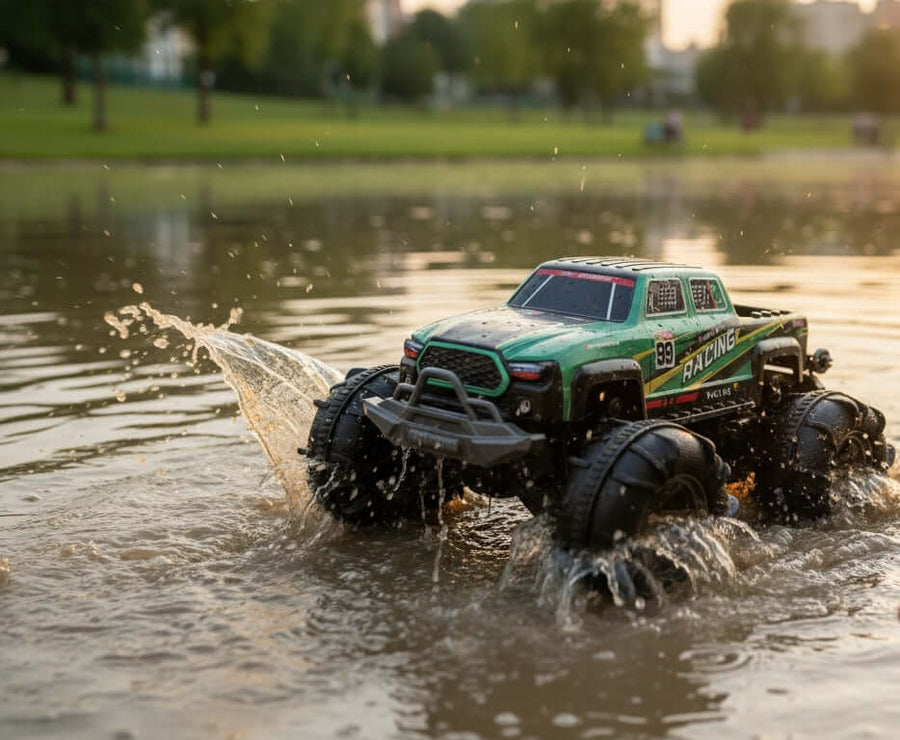
4WD Amphibious Remote Controlled Car Review: Is It Worth It?
A remote control car can look impressive on a product page and still become much less interesting once it leaves a smooth floor. Grass, loose dirt, sand and especially water quickly show the difference between a basic RC toy and a vehicle designed for more demanding conditions.
The 4WD amphibious remote controlled car takes a different approach. It combines four-wheel drive, waterproof construction and stunt functions, so the question is not simply whether it can drive fast. The more useful question is what you can actually do with it once the surface changes.
That makes this model worth looking at as an all-terrain RC vehicle rather than just another remote-controlled toy.
Where Traditional RC Cars Start to Show Their Limits
A standard RC car can be perfectly enjoyable on the right surface. The problem is that the definition of the "right surface" can be quite narrow.
Grass is a good example. A car that feels quick on a hard floor may slow down considerably when its wheels have to deal with longer grass or uneven ground. Sand and gravel create another problem because the surface moves under the tires instead of providing a firm base.
Then there is water. For many conventional RC cars, a puddle is not part of the route — it is something to avoid.
This is where an amphibious design becomes more interesting.
What Does 4WD Actually Change?
The four-wheel-drive system is more than a specification added to the product name. Its practical purpose becomes clearer when the car is being used away from perfectly flat surfaces.
With power going to all four wheels, the vehicle is designed to maintain traction across uneven or loose terrain. Combined with its large off-road tires, this gives it a wider range of surfaces to work with.
You can use it on:
- grass
- dirt
- sand
- gravel
- snow
- wet outdoor surfaces
It does not mean every surface will suddenly become effortless to drive on. Terrain still matters. But the car is designed around the idea that outdoor surfaces are part of normal use rather than an exception.
The Amphibious Part Is More Than a Waterproof Label
Waterproofing is probably the feature that attracts the most attention, but its real value is about where the car can be used.
The 4WD Amphibious Remote Controlled Car can move from land into shallow water without requiring the user to stop and switch to another vehicle.
That opens up some simple but different ways to play. A puddle after rain can become part of the route. A backyard can include both dry and wet sections. Near a suitable shallow-water area, the driving environment becomes less predictable — which is often exactly what makes an RC car more entertaining.
Of course, waterproof construction does not mean that every possible water situation is automatically suitable. The intended use is important, and the vehicle should be used according to its specifications.
360° Stunts Change the Experience
An RC car that only drives forward, backward and around corners can become predictable after a while. This model adds another dimension through its 360° stunt functionality.
The 4WD amphibious RC car can perform spins, flips and quick directional movements.
That matters because you do not always need a large area for this type of play. A small outdoor space can be enough to practise a few movements, while a larger area gives you the option of combining stunts with off-road driving.
It also changes what "driving" means. Instead of simply trying to complete a route as quickly as possible, the user can experiment with how the vehicle reacts to different movements.
What Does It Feel Like to Use?
The appeal of this type of RC car is largely connected to interaction. The remote control lets the driver decide where to go, when to turn and when to attempt a stunt.
For a beginner, the first stage is straightforward: learning the controls and getting used to the vehicle's movement. Once that becomes familiar, the same controls can be used for faster turns, spins and stunt manoeuvres.
The car therefore has more than one learning curve. Someone can simply drive it around, while another user can spend more time experimenting with its stunt functions.
Where Does This RC Car Make the Most Sense?
Backyard and Garden
A backyard provides a useful mixture of surfaces. Grass, dirt, small uneven sections and puddles can all become part of the route.
This is one of the situations where the combination of 4WD and waterproof construction makes more sense than any single feature on its own.
Beach and Sandy Areas
Sand can be frustrating for vehicles that rely on smooth, firm surfaces. The large off-road tires and 4WD system are designed with this kind of terrain in mind.
The driving experience is also different from pavement. The surface gives way under the tires, so controlling the car becomes part of the challenge.
Wet Weather and Puddles
After rain, many outdoor RC cars have to stay away from wet areas. An amphibious model is designed specifically to make shallow water part of the possible route.
This does not mean that water should be treated carelessly. The car is intended for suitable water use, not as a reason to ignore the manufacturer's limitations.
Indoor Stunt Play
The amphibious capability is mainly useful outdoors, but the stunt functions do not depend on having a lake or beach nearby.
Where the available space is suitable, spins and other movements can provide a different way to use the car indoors as well.
One Car Instead of Several Types of RC Toy
The biggest practical difference is versatility.
A conventional RC car may be excellent for one particular environment. Another model might be designed for water, while an off-road vehicle may be better suited to rough terrain.
An amphibious 4WD model combines several of these characteristics in one vehicle.
That does not make it the perfect choice for every possible RC enthusiast. Someone interested specifically in competitive racing, for example, may care about completely different characteristics.
But for general outdoor play, having one vehicle that can move between several environments is a meaningful advantage.
Durability for More Active Driving
Outdoor RC driving is rarely perfectly controlled. Eventually the car will hit something, roll over or encounter a rough section of ground.
The durable construction is intended for this kind of active use.
The important point is not that the car is indestructible — no RC vehicle should be treated that way. Rather, its construction is suited to the bumps, changes in terrain and general handling that come with outdoor play.
This is particularly relevant when the car is being used for stunts. More movement generally means more opportunities for an imperfect landing.
Is It Easy Enough for Beginners?
The controls are designed to be accessible, so a beginner does not need extensive RC experience just to start driving.
There is still a difference between being able to operate the car and being able to control it smoothly during stunts. Like any remote-controlled vehicle, familiarity comes with use.
The advantage here is that the car does not require the user to master everything at once. Basic driving can come first, followed by turns, spins and more ambitious movements.
Is an Amphibious RC Car Worth Considering?
The answer depends largely on what you expect from an RC car.
If the goal is simply to drive around a smooth indoor floor, many basic models can do that. The additional features of this vehicle become more relevant when you actually intend to use different terrain, water and stunt functions.
The strongest combination is therefore not one individual specification but the way several features work together:
- 4WD for uneven and loose terrain
- large off-road tires for outdoor surfaces
- waterproof construction for suitable shallow-water use
- 360° stunt functions for more varied play
- durable construction for active outdoor use
- remote control operation for direct interaction
That combination gives the vehicle a broader range of uses than a conventional RC car.
Final Thoughts
The main reason to consider a 4WD amphibious remote controlled car is not simply that it has more features. It is that those features change where and how the car can be used.
Grass does not necessarily have to end the route. A puddle can become part of it. Sand creates a different driving surface, while 360° stunts provide something to practise even when there is no long track available.
For someone looking for an RC vehicle that combines off-road driving, shallow-water capability and stunt play, this model offers a broader experience than a basic remote-controlled car.
The real value therefore comes down to usage: if you want an RC car that can stay interesting when the environment changes, the amphibious 4WD design gives you considerably more possibilities to explore.